Table of Contents
Thinking about turning that unfinished basement into a family room, a home office, or a guest suite? Great idea. Just make sure it’s dry before you start picking out paint colors and flooring.
Leaks, foundation cracks, and humidity can throw off the whole project. So your basement finishing cost isn’t just about materials and labor. If the house needs waterproofing or repairs first, that money has to come out of the budget too.
If you’ve been searching for basement finishing cost Delaware County PA, you’ve probably noticed the numbers all over the place. That’s normal. A simple open room and a basement with drainage work, separate bedrooms, and a bathroom are really different jobs.
Here’s what to check, which waterproofing options are out there, and how to plan for the extra costs.
Why Should You Waterproof a Basement Before Finishing It?
Water proofing is done first, then we do our finishing. If there’s moisture that gets into the space between the drywall, the insulation and/or the flooring, this can lead to damage to all three types of material, and it will also allow for the growth of mold.
The EPA recommends drying out wet materials within 24 to 48 hours and addressing the source of water infiltration rather than covering it up. This information can be accessed by anyone through the EPA website.
At this point, you should plan to include waterproofing and repair work in your basement renovation budget. By doing so, you can prevent any unexpected expenses from popping up. You should also hire a professional inspector who can locate where the water is coming from and what repairs are needed. That way, when it’s time to install your new finishes, they’ll go down in a prepared space.
How Can You Tell If Your Basement Needs Waterproofing?
Basement waterproofing isn’t a necessary process for all basements. But if you face the problem of recurring moisture, consider it prior to deciding on finishing areas.
Common Signs of Basement Water Problems
Here are some signs to watch out for:
- Water marks: Brown spots or stains on walls and floors.
- Moldy odor: Odor of dampness that won’t dissipate and possibly indicate hidden moisture.
- Bubbling paint: Separating paint on walls.
- Whitish residues: Chalky substances on concrete, called efflorescence.
- Cracks: Cracks in the walls and/or floors of the foundation.
- Puddles: Moisture that shows up after it rains.
The presence of one type of evidence does not mean that all walls and floors need waterproofing. The most important thing is where the moisture is coming from and if the moisture is continuous.
What Makes the Water Come into Your Basement?
Once you have figured out what the cause is, the solution becomes much more obvious. There are usually three sources of water in your basement: bad exterior drainage, foundation problems, and plumbing problems.
Inadequate Exterior Drainage and Poor Grading
If the rain gutters get clogged, and the downspouts and grading of the land around the house are not sufficient, the water might be directed to the house foundation.
It is necessary to make sure that the rain gutters are not clogged and that the water is drained in the right way. It might prevent water damage around your house foundation.
Foundations Cracks and Wall Leaks
The foundations are the structures usually made of concrete and may have cracks. Small cracks are nothing to worry about, but big cracks mean that there is a problem somewhere.
When your house foundation suffers from recurring leaks, you should consider having it checked by experts. A waterproof coating alone probably won’t fix the real problem.
Plumbing Leaks and Excess Indoor Humidity
The fact that your basement is damp does not necessarily mean there is a problem with the foundation. There are other possible reasons why water is entering the basement such as leaks in your plumbing system, faulty connections or condensation.
Condensation happens when warm, humid air comes into contact with the cool surface of the basement wall. A dehumidifier could be an effective solution for this problem but not if the water is caused by leakage from the pipes or seepage through the ground.
What Basement Waterproofing Approaches Should Be Used by Homeowners?
It will depend on how and where the water enters, how often the problem happens, and whether your foundation is healthy.
Interior Waterproofing of the Basement
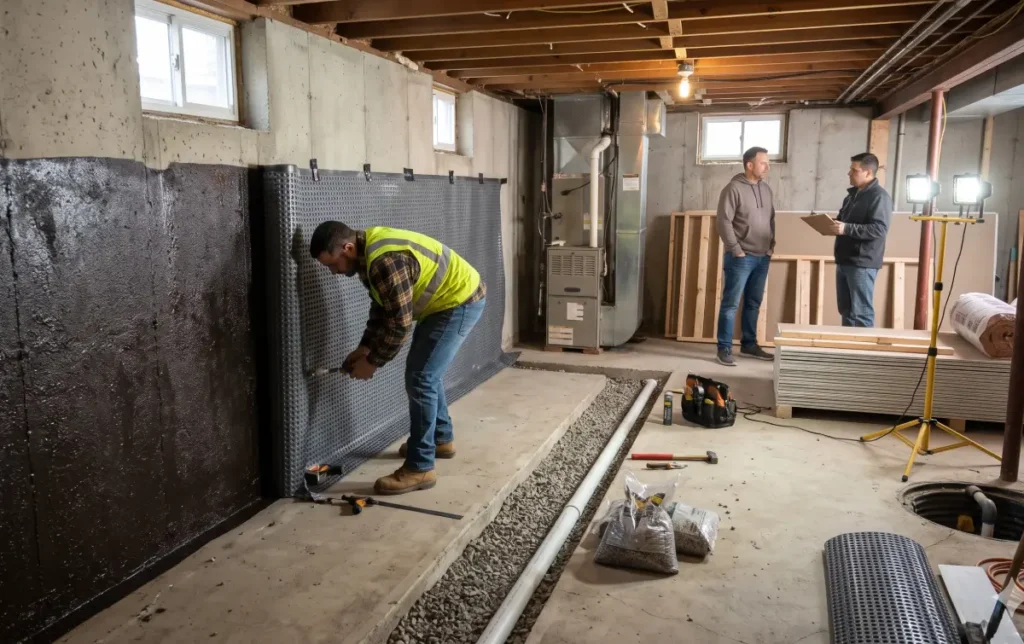
Methods for interior waterproofing are drainage trenches, wall treatments, sump pumps, and moisture barriers. Wall treatments may fix the small problem but will not serve as a proper drainage for high-pressure water.
Exterior Waterproofing
Exterior waterproofing is digging to the outside foundation walls, adding a protective barrier and enhancing the drainage system around the home.
This technique will protect the foundation from the water, but excavations and destruction of landscaping may increase labor costs.
French Drains and Sump Pumps
An interior French drain collects water along the perimeter of the basement and directs it into the sump pit. The sump pump will push the water out of the basement.
This approach is more appropriate in case of the water that repeatedly comes up near the joint of the floor and the wall or even accumulates under the floor.
Crack Repair and Foundation Sealing
A single crack may only need a targeted injection or repair. Widespread seepage or signs of structural damage call for a more thorough look.
Published Pennsylvania waterproofing estimates give these rough ballpark ranges:
| Waterproofing work | Approximate cost |
| Single foundation crack repair | 300–1,000 |
| Interior sealants and coatings | 500–3,000 |
| Sump pump installation | 1,000–4,000 |
| Interior French drain with sump pump | 4,000–12,000 |
| Exterior excavation and waterproofing | 8,000–15,000+ |
These are meant to be estimates of what the market pays and not set rates for Delaware County. Your actual cost depends on your foundation, drainage needs, and how easy the area is to get to.
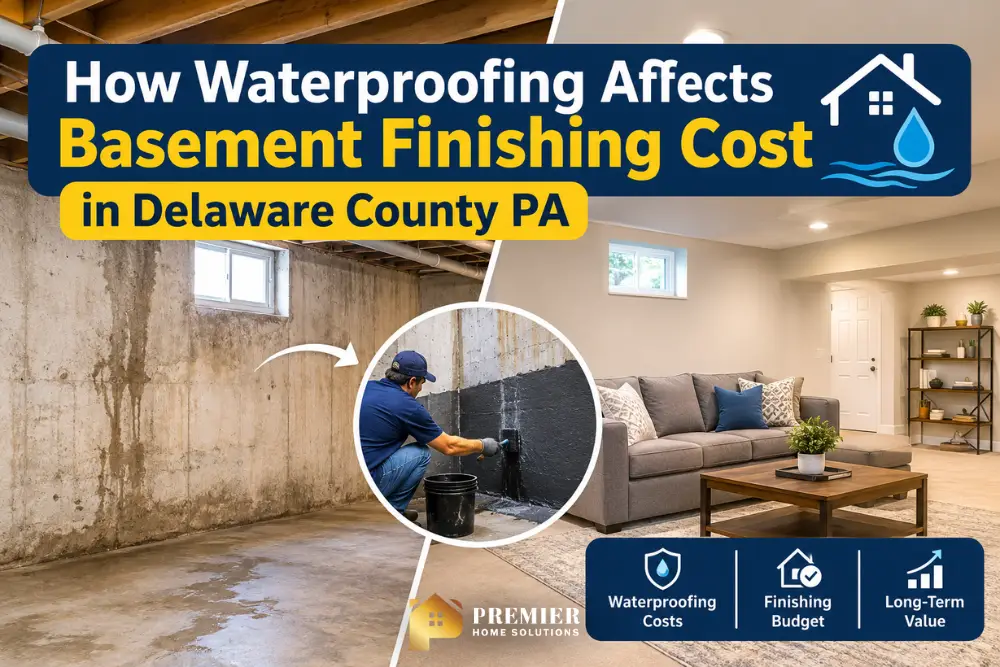
How Does Waterproofing Affect Basement Finishing Cost in Delaware County PA?
Waterproofing will increase your cost, but not waterproofing when there is already an issue with water will cost you more in the long run.
The cost of a remodeled basement may rise due to the demolition of damaged drywall, insulation, flooring, or trim by the contractor before repairing it.
Various factors influence the additional cost:
- Basement size and foundation perimeter.
- How bad the water intrusion is and where it’s happening.
- The type of waterproofing system you need.
- Foundation condition and how accessible it is.
- Removing and replacing damaged materials.
A small, isolated leak might need a quick targeted fix. Seepage along several walls may call for a complete drainage system.
Want to Remodel Your Basement?
Begin With an Assessment
Prior to selecting floor coverings, paints or other finishes, ensure that your basement is ready for renovations. At Premier Home Solutions, we can help you create a plan for remodeling and see what your home requires. Please call us at (302) 464-5665 to schedule a free design consultation.
How Much Should You Budget for Waterproofing Before Finishing a Basement?
Your total depends on what the space looks like now and what you want to build. An open family room needs fewer changes than a basement with bedrooms, a bathroom, and a wet bar.
What Does It Cost to Finish a Basement Per Square Foot?
Cost per square foot is a handy starting point when you’re comparing estimates, but it won’t tell you the whole story.
Published 2026 pricing references include:
| Project scope | Approximate cost per sq. ft. |
| General national finishing estimate | 30–50 |
| Pennsylvania open-plan finish | 35–55 |
| Pennsylvania multi-room finish | 50–75 |
HomeGuide’s 2026 national guide and Pennsylvania contractor estimates show how much scope changes the price. Use these as planning benchmarks, not fixed local rates.
What Do Different Basement Finishing Projects Cost?
A Media, PA contractor publishes these Delaware County project examples:
Project type Published price range
Basic 700–1,000 sq. ft. finish 15,000–25,000
More involved layout with additional features 25,000–45,000
These are one contractor’s package estimates, not countywide averages. However, you need to understand what is offered by each one before comparing the prices.
The cost of waterproofing a basement of 1,000 square feet, ranging from 35 to 55 dollars per square foot, amounts to 35,000 to 55,000 dollars for an open design. On the other hand, waterproofing with more complex finishes at 50 to 75 dollars per square foot would range between 50,000 and 75,000 dollars.
What Other Costs Must You Take Into Account?
Apart from waterproofing, there are other factors such as the addition of rooms and materials that may affect the overall costs significantly.
Additional bathrooms will require plumbing, drainage, ventilation, and other fixtures. When you’re comparing Full Bathroom Remodeling Delaware County PA services, check exactly what each estimate covers.
Flooring matters too. Typical flooring materials are luxury vinyl plank, carpet, tiles, and polished concrete; all have different approaches to dealing with comfort and moisture.
There is also wall preparation and painting which affects the budget. The cost of professional interior painting work depends upon the condition of the wall and the amount of coating needed.
In case of different flooring solutions, one must consider their durability, maintenance, and suitability for basements.
Can the Cost of Waterproofing Basements be Decreased Prior to Renovation?
Yes, regular maintenance and repair can prevent future water problems.
Outside is where you start to prevent moisture in your basement. Make sure your gutters are clean, your downspouts are long enough to direct water away from the foundation of your home, the grade of the soil around your home is sloping down from the home, and repair all leaks in your pipes immediately.
You may also want to compare your options for repairing the problem, and use as many of your current materials as possible. However, make sure you don’t choose a quick, inexpensive fix that doesn’t address the root cause of the problem.
Create a savings fund to cover unexpected costs. When you take off old wall and/or floor coverings, there is a possibility that you will find hidden damage or plumbing issues that were not identified during the initial inspection.
When Is It Safe to Start Basement Finishing After Waterproofing?
Don’t install new walls, insulation, or flooring until waterproofing is completed and moisture is controlled.
A good plan should be something like this:
- Locate the cause of the moisture.
- Fix problems with drainage, foundation, or plumbing systems.
- Examine the area after rain or system use.
- Discard things that can’t be dried and cleaned.
- Ensure the basement is dry before installation of any finishing materials.
Even though the dehumidifier will regulate the humidity level in your house, it won’t mask leaking problems. The Environmental Protection Agency advises that you maintain a level of humidity within your house below 60%, ideally 30 to 50%.
Another consideration is radon test before occupancy of the basement area. The Pennsylvania DEP reports that about 40% of tested Pennsylvania homes exceed the EPA’s radon action guideline. Testing is the only way to know your levels. See Pennsylvania DEP radon guidance.
What Should You Ask a Basement Waterproofing Contractor Before Hiring?
A proper inspection will tell what needs to be done. So before going ahead ask these questions:
- Where does the water come from?
- Is it a drain issue, foundation crack, or plumbing?
- What type of repair would you suggest?
- Is it inclusive of material and labor cost?
- Will existing walls or floors need to come out?
- Is there any need for permits and inspections?
- Which warranty protects the completed job?
Get an itemized estimate for basement finishing that includes waterproofing, repairs, and finishing to enable you to get comparable estimates from different contractors.
In case of larger projects, seek Home Remodeling Delaware County PA companies that are able to handle draining, framing, wiring, and finishing.
The state of Pennsylvania uses the Uniform Construction Code, however, permitting requirements vary by municipality. Consult your local construction office before you proceed.
Address Moisture Before Investing in a Finished Basement
By taking action on waterproofing sooner than later, you help to preserve your new products and save yourself from making frequent repairs. What will ultimately be the cost of your basement finishing depends on the condition of your property, the necessary repairs, and the finishes that you select. With the basement already dry, you may install various additions such as Tile installation Delaware County PA.
Premier Home Solutions is a family-owned remodeling company operating out of Delaware County, Pennsylvania. The services provided by this company include tile installation, flooring, interior painting, and bathroom remodeling. To help its customers with the preparation stage, Premier Home Solutions provides free design consultation.
Are you thinking about making updates to your home? You can reach out to Premier Home Solutions by calling (302) 464-5665, or you can go online to set up an appointment for a consultation.
FAQs
How Much Does it Cost to Finish a Basement in PA?
The recent estimates range between 30 and 75 dollars per square foot, depending on design and finishing materials. Waterproofing increases the cost.
How Much Does It Cost to Finish Basement Per Square Foot On Average?
A basic cost for basement finishing will be 30 to 50 dollars per square foot, while complicated projects can reach 75 dollars per square foot.
How Much Does It Cost to Finish a 1,000 Square-Foot Basement?
The cost of finishing the basement of an open plan will range from 35,000 to 55,000 dollars, whereas the multi-room plan will cost you about 50,000 to 75,000, excluding waterproofing.
Can You Finish a Wet Basement?
Yes, but first the wetness problem must be resolved. It can involve foundation repair, improved drainage systems, plumbing, or moisture control system.
Do I Need a Permit for Finishing My Basement in Delaware County, PA?
Most likely, yes. However, it depends on specific circumstances. Contact your local building department for additional information.